Prismtect › Constellations › Ursa Major
Ursa Major
the Great Bear
- Brightest star
- Alioth
- Best seen
- all year in the north, highest in spring, in the evening
- Where
- Best from the Northern Hemisphere; from most of Europe, North America and northern Asia part of it never sets.
- Abbreviation
- UMa
How to find Ursa Major
Seven stars of the Great Bear make the Big Dipper (the Plough): a bowl and a bent handle. The two stars at the front of the bowl, Merak and Dubhe, point to Polaris, the North Star.
The story
In Greek myth the bear is Callisto, loved by Zeus and turned into a bear. Many other peoples saw the same stars differently: a plough, a wagon, seven sages, or a ladle.
Worth knowing
In the bend of the handle, a sharp eye can see two stars close together, Mizar and Alcor, long used as an eyesight test.
The Big Dipper in eight cultures
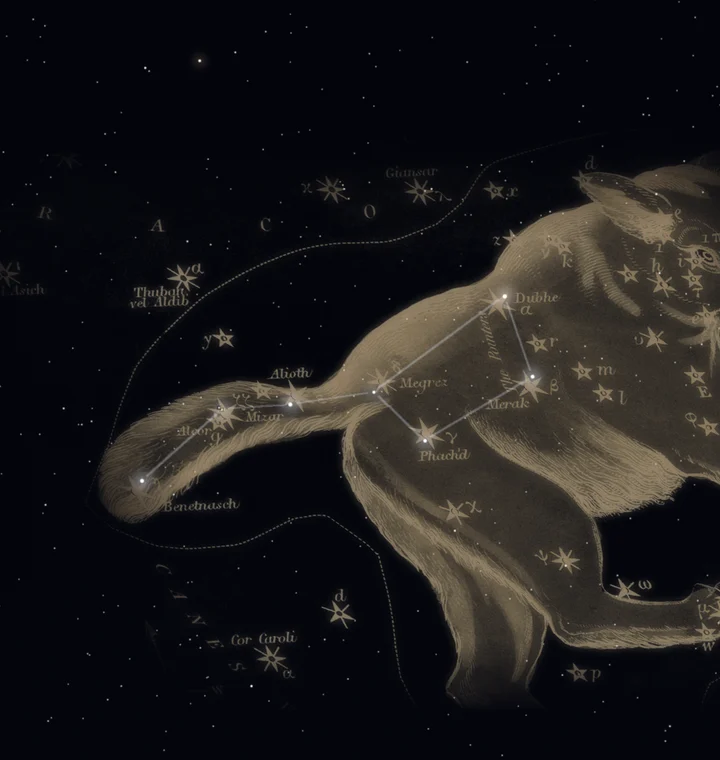 Greece
In Greek myth the nymph Callisto was turned into a bear, and Zeus set her in the sky as the Great Bear. The seven bright stars lie on her back and tail.
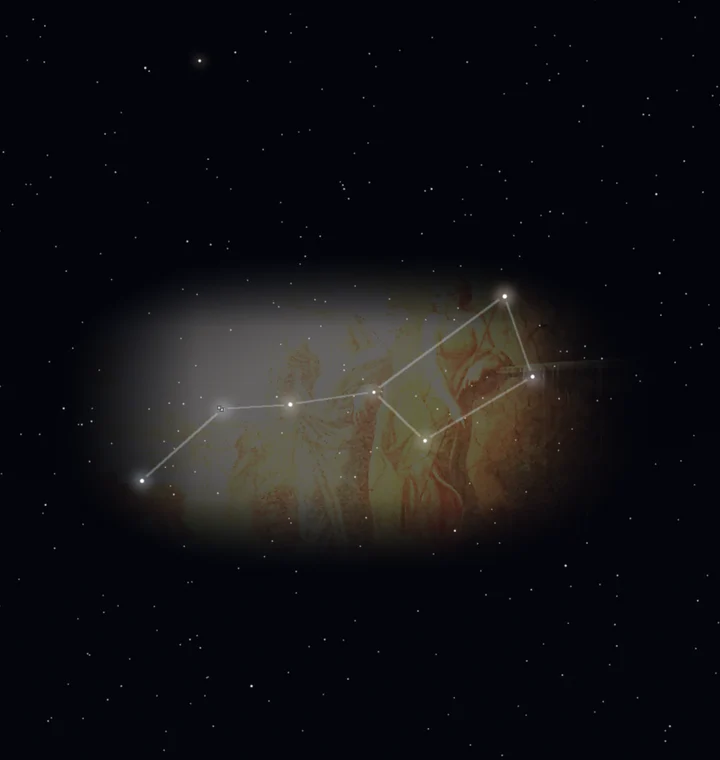 Rome
Ovid tells how Callisto's own son, out hunting, almost killed her as a bear, and Jupiter lifted them both into the sky. Annibale Carracci painted the story.
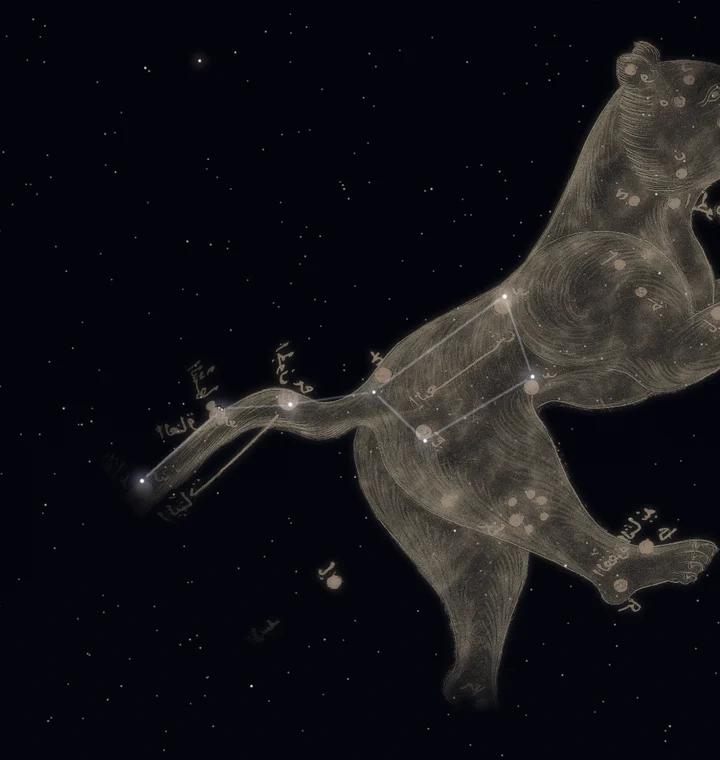 Arabia
Arab sky-watchers saw a funeral: the bowl is a bier and the handle is the mourners walking behind it. Al-Sufi drew the bear in his Book of the Fixed Stars around 964.
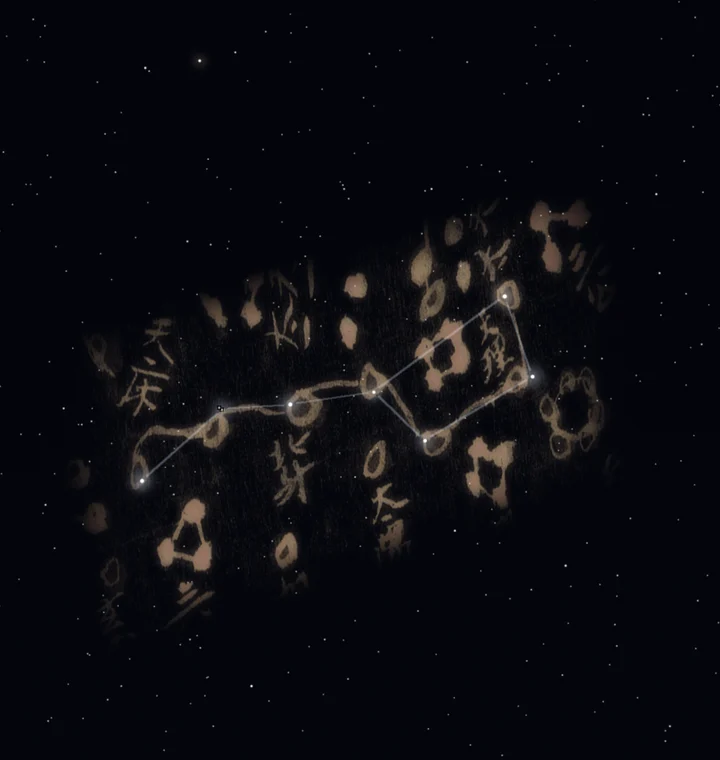 China
In China the seven stars are Beidou, the Northern Dipper, and where its handle points was said to tell the season. This map from Dunhuang draws a small group of stars inside its bowl.
 Korea
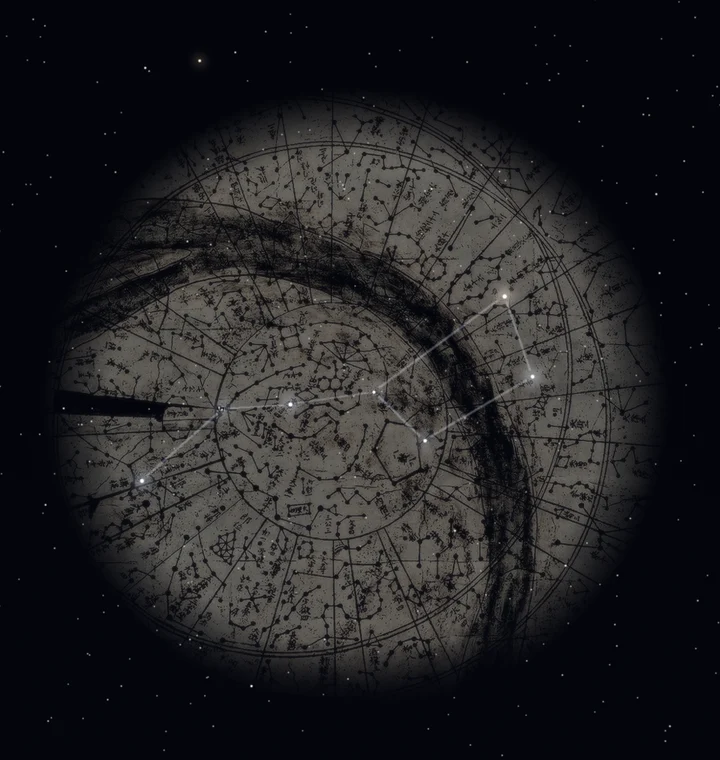
In Korea they are the Seven Stars of the North. A widow's seven sons laid stepping stones across a stream for her, and when they died they became these stars. The 1395 stone chart shows them near the pole.
 India
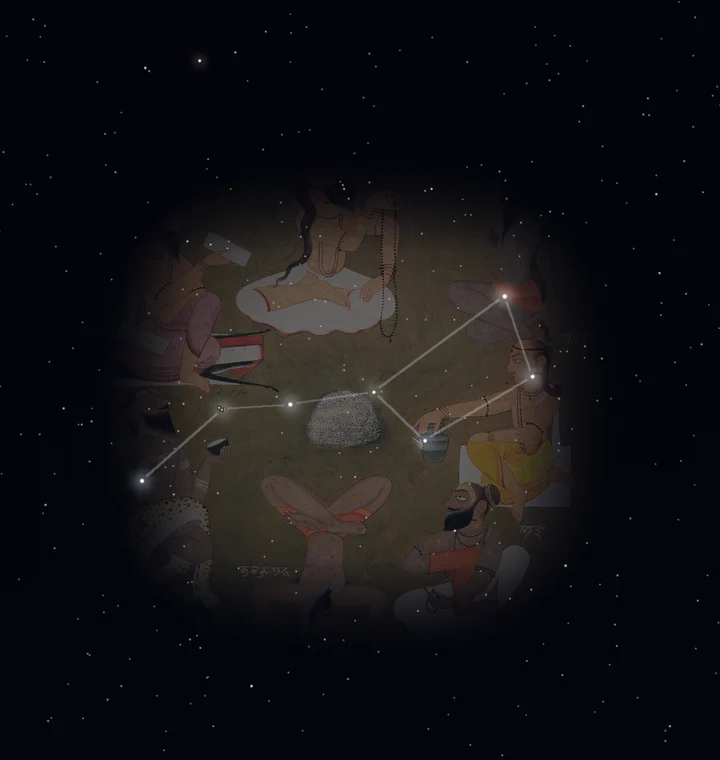
In the Rigveda the seven stars are the Saptarishi, seven great sages such as Vasishtha, Atri and Bhrigu. This painting shows the seven seated together.
 Mi'kmaq (eastern Canada)
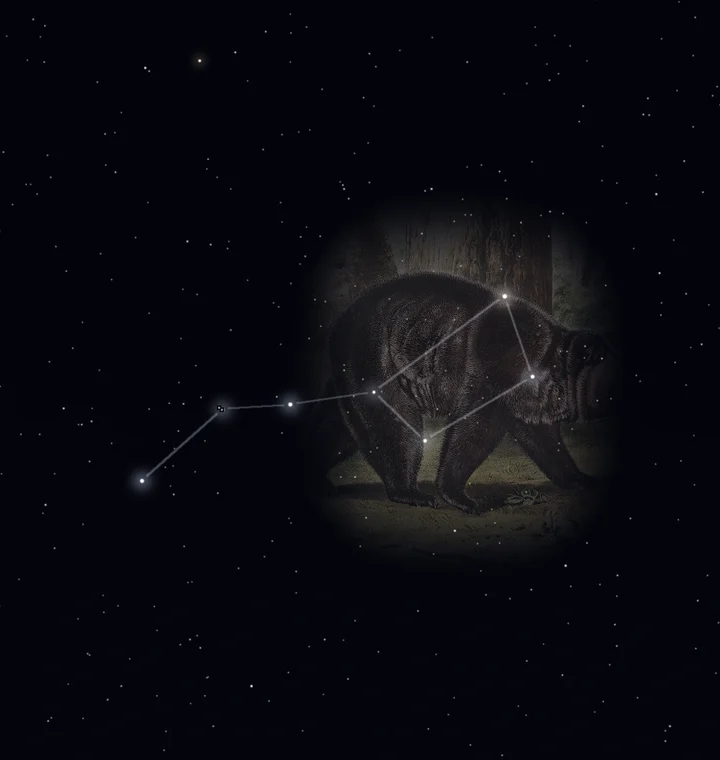
For the Mi'kmaq the four stars of the bowl are Muin, the bear, and seven bird hunters follow her round the sky all year.
Read the whole story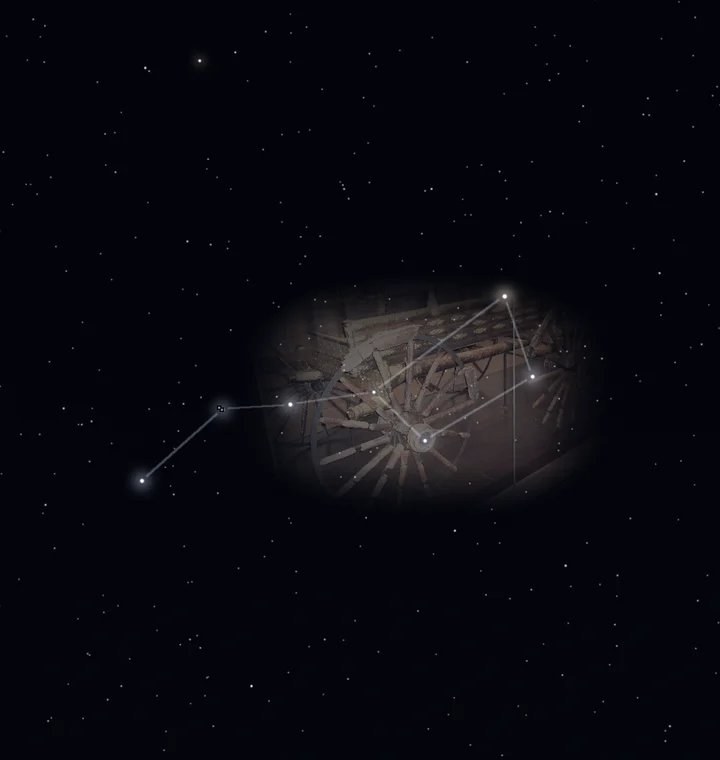 Norse
Norse pagans called it Odin's Wagon. The picture is the Dejbjerg wagon, a ceremonial wagon over 2,000 years old found in a Danish bog.
Muin and the seven bird hunters (Mi'kmaq)
The Mi'kmaq of Nova Scotia told this story to the anthropologist Stansbury Hagar by their summer campfires, pointing to the stars overhead. The four stars of the bowl are Muin, the bear. Seven birds hunt her: the three stars of the handle and four more in Boötes. The little star beside the middle one, Alcor, is the pot the chickadee carries to cook the meat. Above them a ring of stars, the Northern Crown, is her den.
In spring the bear wakes, leaves her den and comes down to look for food. The sharp-eyed chickadee sees her first and calls the others, and all summer the seven chase her low around the northern sky.
In autumn the hunters at the back lose the trail one by one: first the two owls, then the blue jay and the pigeon. Only the robin, the chickadee and the gray jay keep going, and in the middle of autumn they catch her.
The bear rears up, and the robin's arrow brings her down. He jumps on her in his hunger, is covered in blood, and flies to a maple to shake it off. One spot stays on his breast. The rest falls on the forests below, which is why the leaves turn red every autumn, and the maples reddest of all.
The robin and the chickadee cook the meat, and the gray jay arrives just in time to eat. Ever since, he turns up whenever a hunter kills an animal, so he is called He-who-comes-in-at-the-last-moment.
All winter the bear's skeleton lies on its back in the sky. Her spirit has gone into another bear, asleep and unseen in the den, and when spring comes she walks out and the hunt begins again.
Source: Stansbury Hagar, "The Celestial Bear", Journal of American Folk-Lore 13 (1900), 92–95
Around the world
A very old hunt
Several connected cultures saw these stars as a bear, and many stories make it an animal being hunted. Using statistical methods, the researcher Julien d'Huy traced this "cosmic hunt" story back more than 13,000 years. In its oldest form, he suggests, a hunter chases a horned animal such as an elk, and the animal becomes the Big Dipper while still alive.
Arabic
Arab sky-watchers saw a funeral. The bowl is a bier carrying a body and the handle is a line of mourners following it. The Big Dipper was "the greater funeral procession", and the Little Dipper "the lesser". In one legend the dead man is Na'ash, killed by the North Star, and his children follow the bier in pursuit of the killer.
Indian (Hindu)
In the Rigveda, one of the oldest texts in the world, the seven stars are the Saptarishi, seven great sages, each with a name, such as Vasishtha, Atri and Bhrigu.
Chinese, Japanese and Korean
In China and Japan the seven stars are the North Dipper (Beidou, Hokuto), and each star has its own name, such as "Pivot", "Beautiful Jade" and "Opening of the Yang". In Shinto, the seven stars belong to Ame-no-Minakanushi, the oldest of the kami. In Korea they are "the seven stars of the north". The story tells of a widow with seven sons who found comfort with a widower across a stream. Her sons, feeling for her, laid stepping stones so she could cross. Not knowing who had done it, she blessed them, and when they died they became the seven stars.
Haudenosaunee and other Native American peoples
For the Haudenosaunee (Iroquois), the three stars of the handle are hunters chasing the Great Bear. The first carries a bow, the second carries a cooking pot (the little star Alcor), and the third brings firewood. The Lakota call it the Great Bear. The Wasco-Wishram people saw five wolves and two bears, left in the sky by Coyote.
Norse, Finnish and Sámi
Norse pagans called it Odin's Wagon. The old Finnish name Otava means a salmon weir. For the Sámi of northern Europe, part of the Dipper is the bow of the great hunter Fávdna (the star Arcturus). Every night he is ready to shoot the Great Reindeer, but he holds back, because a miss could hit the North Star, the rivet that holds up the sky.
Folk beliefs and customs
- Pumpkins for the Big Dipper. On Chilseok, the seventh night of the seventh lunar month in Korea, people traditionally offered fried pumpkins to the Big Dipper.
- Sending the bear home. Ancient Finns believed bears came down to earth from Ursa Major in a golden basket. When a bear was killed, its head was set in a tree so its spirit could go back to the stars.
- The Sámi anthem. The Sámi national anthem opens with the Sámi homeland coming into view far in the north, "under the Bow".
- Follow the Drinking Gourd. This American folk song refers to the Big Dipper.
Free during the beta.
On Prismtect you write any sentence, a glass prism turns it into eight numbers, and a constellation is drawn in the sky for it, with a card to keep. Your sentence is not shown on the card.
Milky Way wallpapers in 4K
A moving wallpaper you can touch (Windows)
More constellations
- Andromeda
- Aquila
- Auriga
- Bootes
- Canis Major
- Cassiopeia
- Cepheus
- Columba
- Corona Borealis
- Corvus
- Crux
- Cygnus
- Delphinus
- Draco
- Hercules
- Hydra
- Lepus
- Lyra
- Orion
- Pegasus
- Perseus
- Sagitta
- Ursa Minor
Pictures and star positions
Each picture is a work from Wikimedia Commons, set over star positions from the HYG Database v4.0 (astronexus), CC BY-SA 4.0. The licence of each work is given below.
- Greece: Sidney Hall, Urania's Mirror: Ursa Major (1824) (Public domain)
- Rome: Annibale Carracci, Callisto turned into a bear (Public domain)
- Arabia: al-Sufi, Book of the Fixed Stars: Ursa Major (Bodleian Library, Marsh 144) (Public domain)
- China: Dunhuang star map (Public domain)
- Korea: Cheonsang Yeolcha Bunyajido, woodcut version (Public domain)
- India: Saptarishi, the Seven Sages (Public domain)
- Mi'kmaq (eastern Canada): John Woodhouse Audubon, American Black Bear (1845), via rawpixel (CC BY 2.0)
- Norse: Simon Burchell, Dejbjerg wagon, National Museum of Denmark (CC BY-SA 3.0)
- Star positions: HYG Database v4.0 (astronexus), CC BY-SA 4.0


