Prismtect › Constellations › Orion
Orion
the Hunter
- Brightest star
- Rigel
- Best seen
- December to March, in the evening
- Where
- Seen from almost everywhere on Earth; it lies on the celestial equator.
- Abbreviation
- Ori
How to find Orion
Look for three bright stars in a short straight row: Orion's Belt. Above it, the orange star Betelgeuse marks a shoulder; below it, blue-white Rigel marks a knee. Follow the Belt down and to the left and you reach Sirius, the brightest star of the night sky.
The story
In Greek myth Orion was a giant hunter. One story says he boasted he could kill every animal on Earth, and a scorpion was sent to stop him; that is why Orion sets in the west as Scorpius rises in the east, and the two are never in the sky together.
Worth knowing
Below the Belt hangs the Sword, and in its middle the Orion Nebula, a cloud where new stars are forming, faintly visible to the eye on a dark night.
Orion in twelve cultures
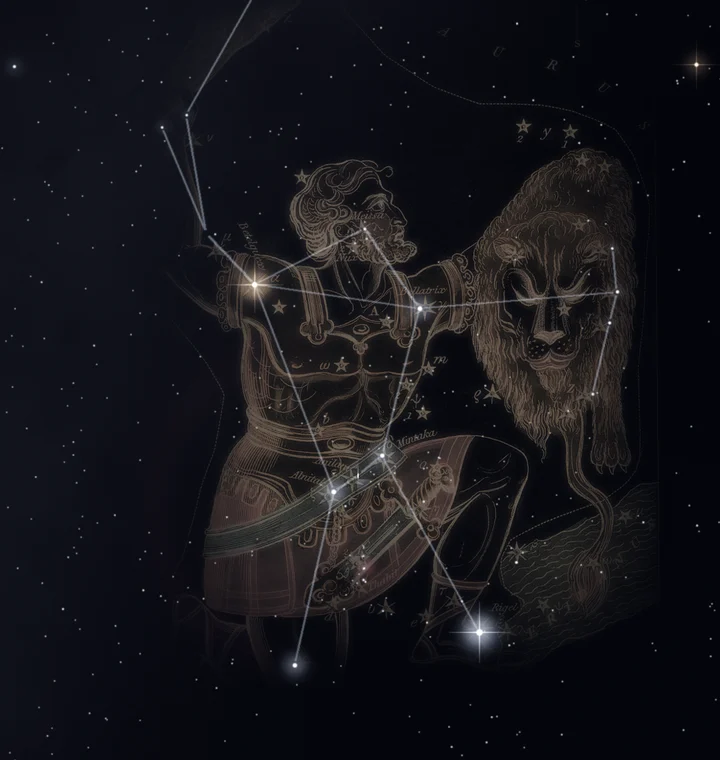 Greece
In Greek myth Orion is a giant hunter. A scorpion was sent to stop his boasting, so he sets as Scorpius rises.
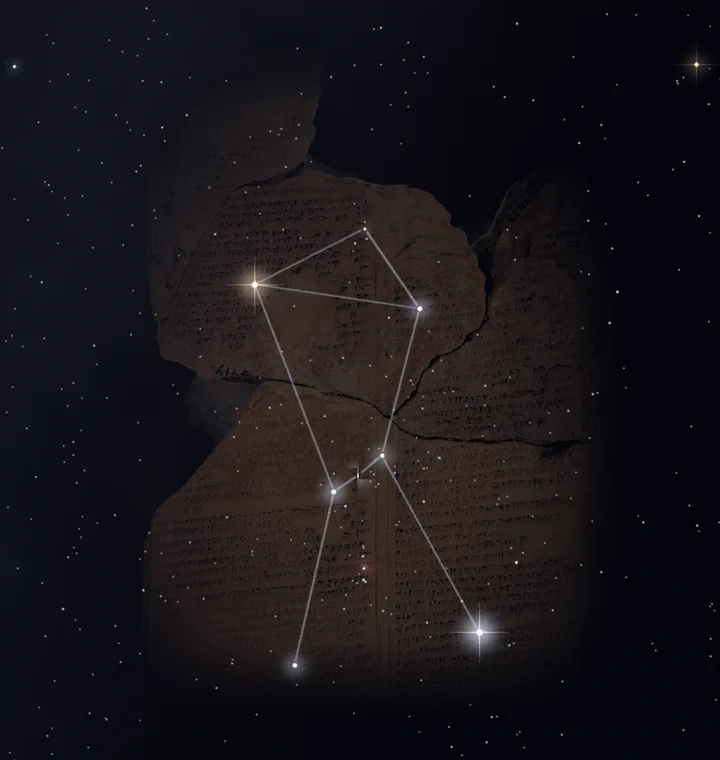 Babylon
ian star lists call Orion “the True Shepherd of Anu”, the chief god of the heavens.
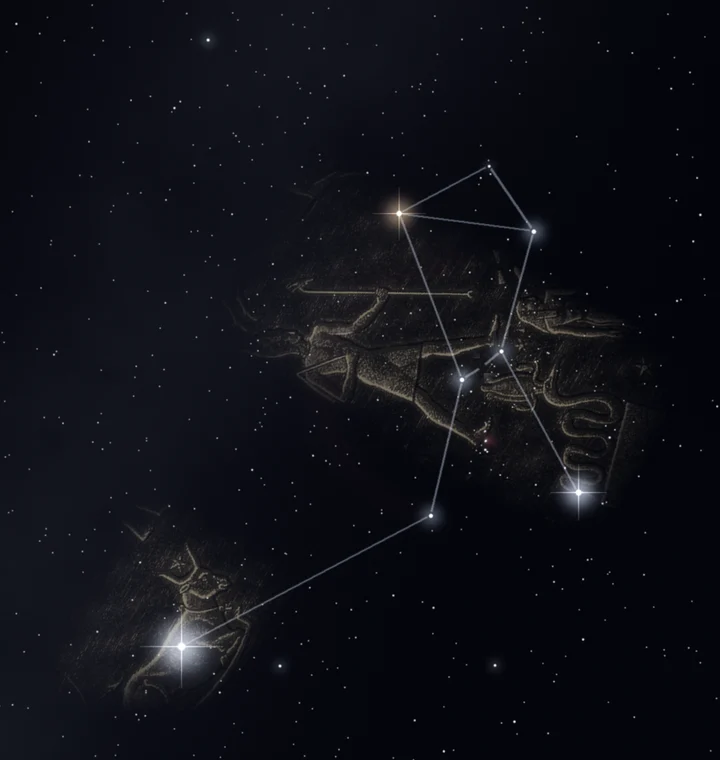 Egypt
In Egypt these stars were the god Sah, paired with Sopdet, the goddess of Sirius.
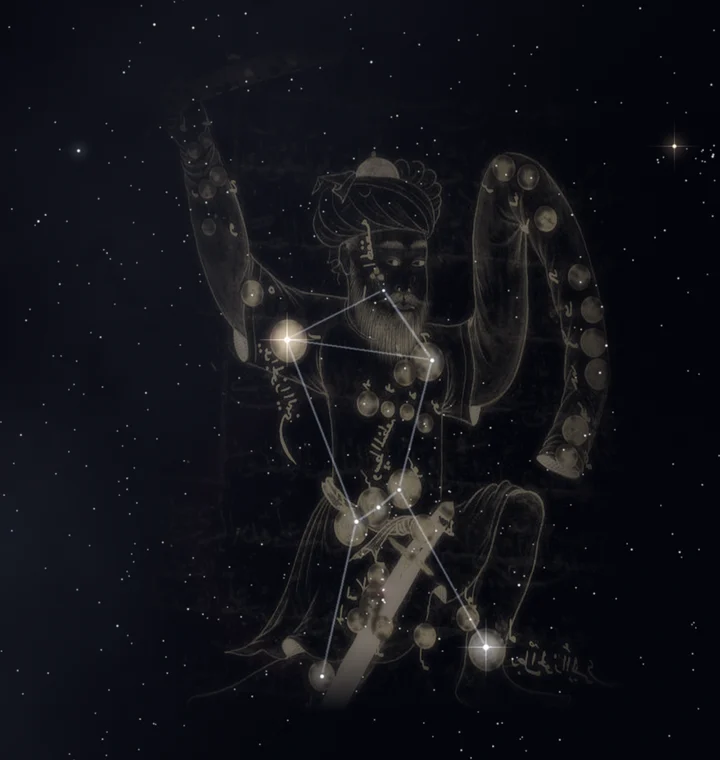 Arabia
Arab sky-watchers saw a female figure, al-Jawza’. After the Greek picture came, Orion was also al-Jabbar, “the giant”.
 Korea
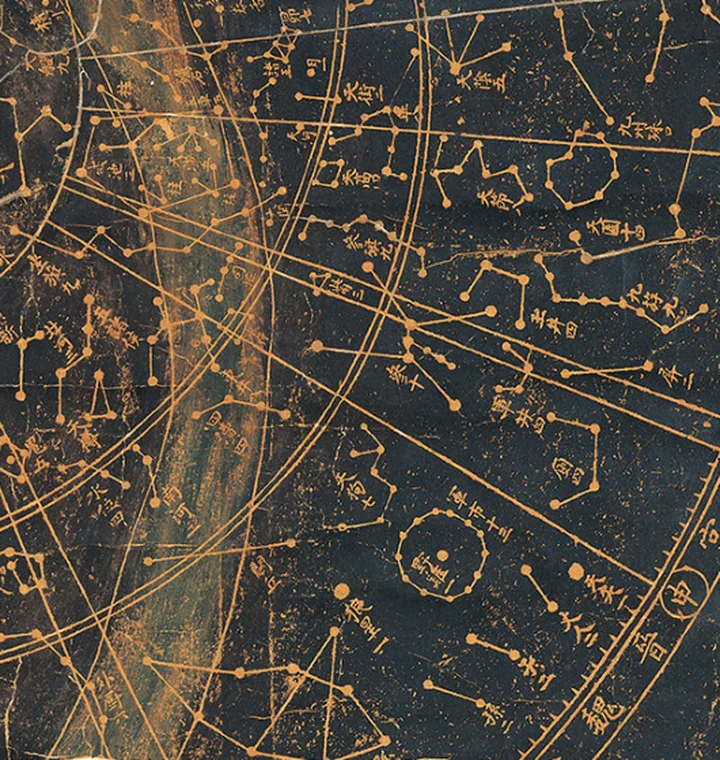
In Korea the three Belt stars are sometimes called Samtaeseong. A Korean folktale tells of triplet brothers born near a great marsh. One could fly on a magic cushion, one could see ninety thousand li, one was a master of the sword and bow. When a pair of black dragons swallowed the sun, the brothers flew up, made the dragon spit it out, and then rose into the sky to guard the sun forever as Samtaeseong.
 China
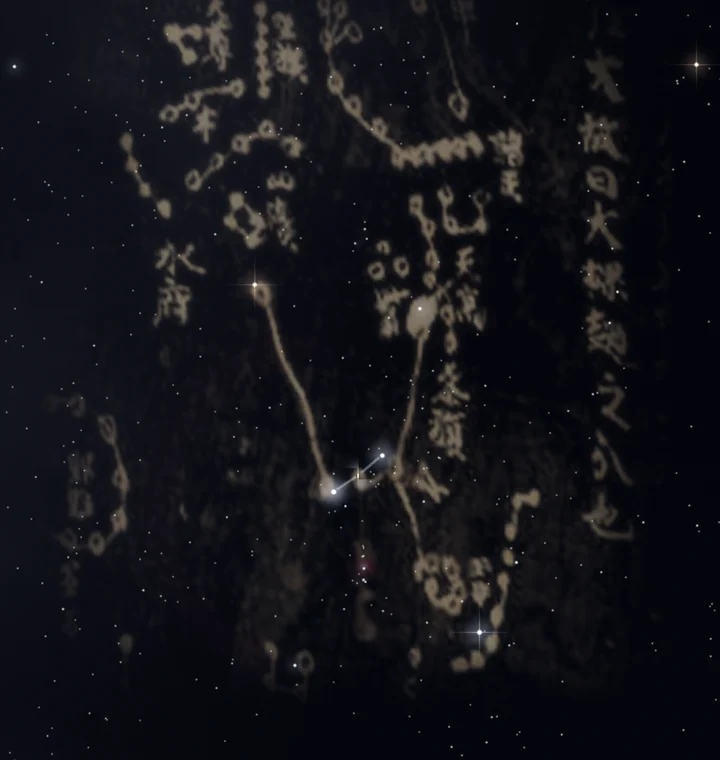
In China the three Belt stars were Shen, “three”, which also named one of the 28 lunar mansions.
 India
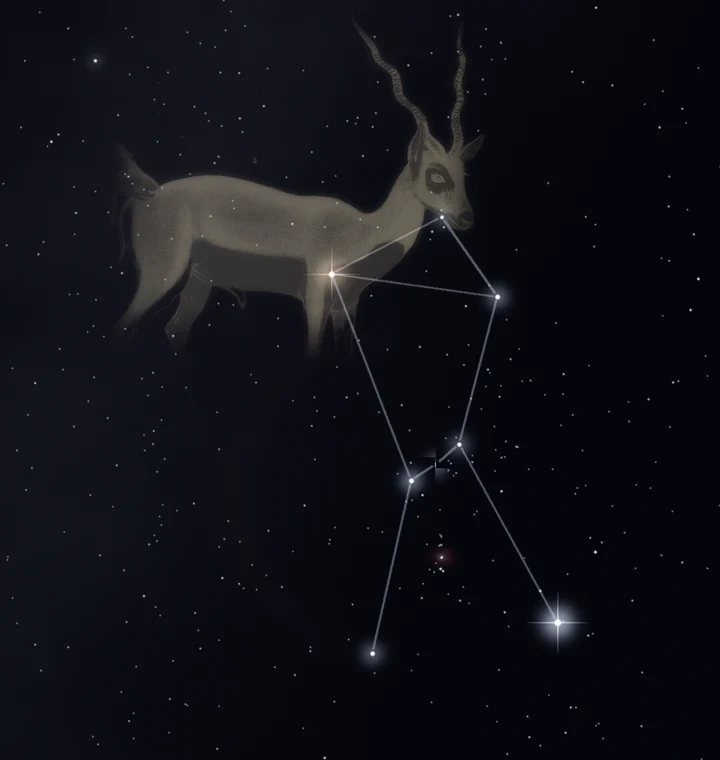
In India the constellation is Mriga, “the deer”. The Aitareya Brahmana tells how the god Prajapati, as a deer, was struck by an arrow and flew up into the sky.
 Lakota
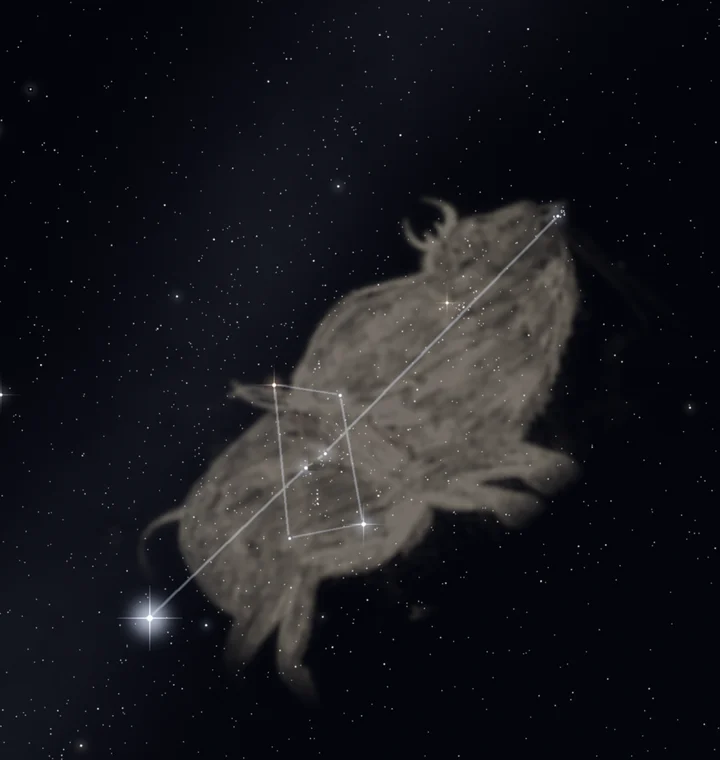
To the Lakota the Belt is the spine of a bison. The great rectangle is its ribs, the Pleiades its head and Sirius its tail.
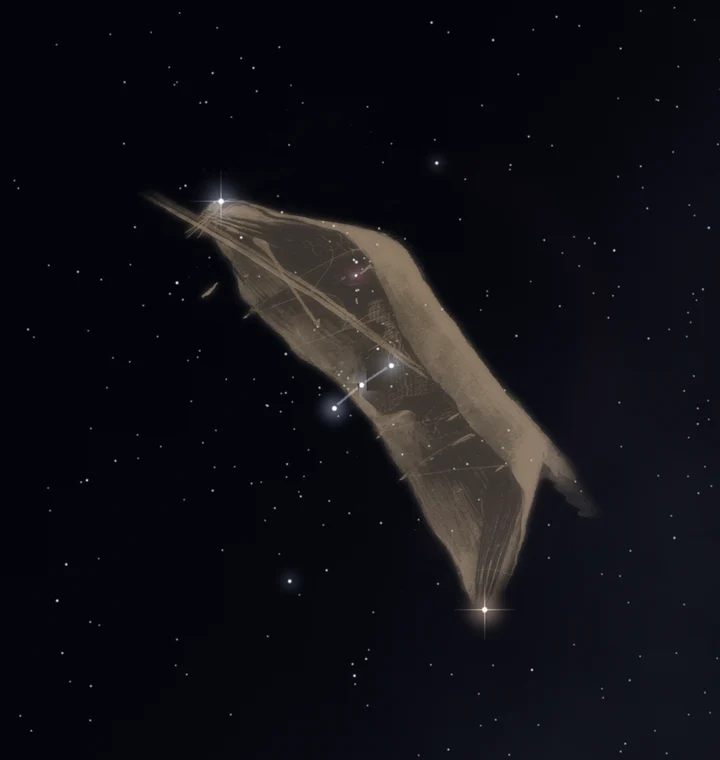 Yolŋu (Australia)
The Yolŋu of northern Australia see a canoe, Julpan. Three brothers ate a fish their law forbade, and a waterspout lifted them and their canoe into the sky.
Read the whole story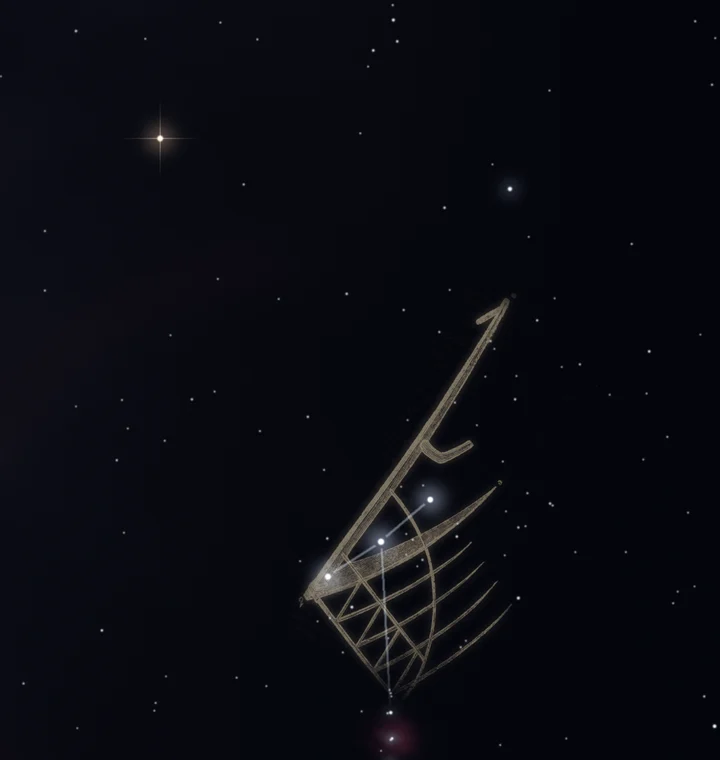 Finland
Finns call the Belt and the stars below it Väinämöinen’s scythe.
 Spain and Latin America
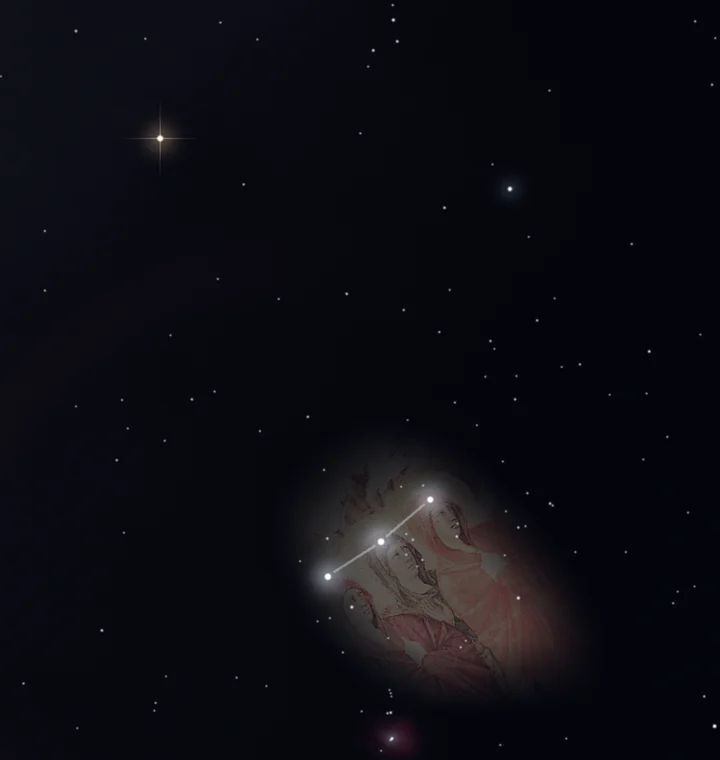
In Spain, Latin America and the Philippines the Belt is “the Three Marys”.
 Australia and New Zealand
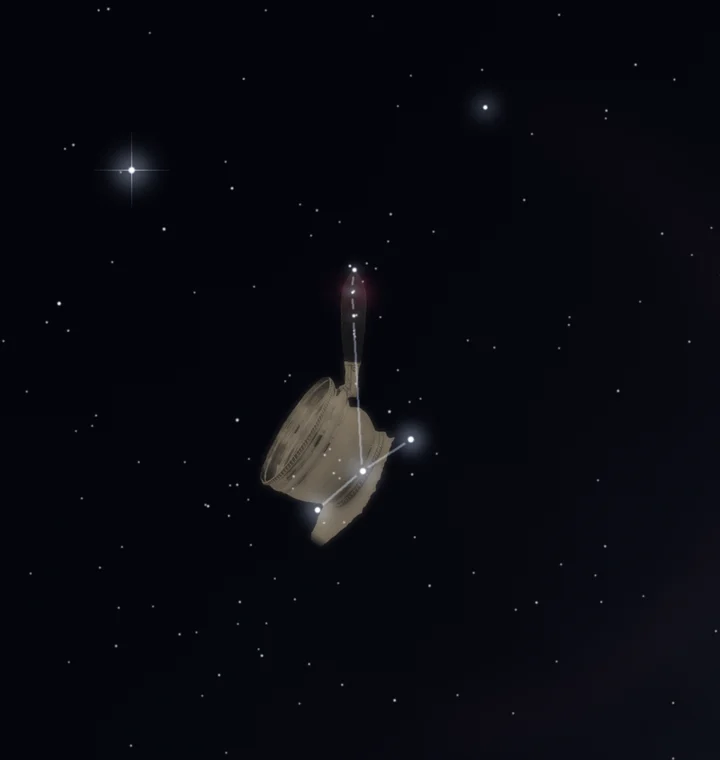
In Australia and New Zealand the sky is upside down, and the Belt and Sword are “the saucepan”.
The Yolŋu canoe, Julpan
The Yolŋu of northern Australia see a canoe in these stars. They call it Julpan.
Three brothers went out fishing. One of them ate a sawfish, a fish their law forbade.
The Sun-woman sent a waterspout. It lifted the three brothers and their canoe into the sky.
Up there the three brothers are the Belt. The Orion Nebula is the fish, and Betelgeuse and Rigel are the two ends of the canoe.
This is a short telling. The story belongs to the Yolŋu.
Source: en.wikipedia.org/wiki/Australian_Aboriginal_astronomy
Around the world
Mesopotamian (Babylonian)
Babylonian star lists call Orion "the True Shepherd of Anu", the chief god of the heavens. It was sacred to messenger gods who carried word between the gods.
Ancient Egyptian
In Egypt these stars were the god Sah. Orion rises just before Sirius, whose return began the Egyptian year, so Sah was paired with Sopdet, the goddess of Sirius. Later Sah was identified with Osiris and Sopdet with Isis. In the Pyramid Texts, a dead pharaoh takes the form of Sah in the afterlife.
Arabic
Arab sky-watchers saw a female figure, al-Jawza'. Betelgeuse comes from yad al-Jawza', "the hand of al-Jawza'". Later, after the Greek picture was adopted, Orion was also called al-Jabbar, "the giant".
Chinese and Indian
In China Orion was Shen, "three", for the Belt stars, and gave its name to one of the 28 lunar mansions. The Shang-era form of the character shows three stars over a man's head. In India the constellation is Mriga, "the deer". The Aitareya Brahmana, a text attached to the Rigveda, tells how the god Prajapati, in the form of a deer, was struck by an arrow and flew up into the sky.
Lakota and other Native American peoples
To the Lakota, the Belt is the spine of a bison. Orion's great rectangle is its ribs, the Pleiades its head and Sirius its tail. Another Lakota story sees the lower half of Orion as a chief's hand, torn off by the Thunder People. A young warrior called Fallen Star brought it back. The Ojibwe call Orion Mesabi, "big man". The Seri of Mexico see the Belt as three animals, a mule deer, a pronghorn and a bighorn sheep, chased by a hunter.
Aboriginal Australian (Yolŋu)
The Yolŋu of northern Australia see a canoe, Julpan. Three brothers went fishing and one ate a sawfish their law forbade. The Sun-woman sent a waterspout that lifted the brothers and their canoe into the sky. The Belt is the brothers, the Orion Nebula is the fish, and Betelgeuse and Rigel are the two ends of the canoe.
Finnish, Hungarian and Scandinavian
Finns call the Belt and the stars below it Väinämöinen's scythe. In old Hungarian tradition Orion is an archer or a reaper, and in recently rediscovered myths it is Nimród, the great hunter. In Scandinavia the Belt was the distaff of the goddess Frigg or Freyja.
Folk beliefs and customs
- Māori new year. Rigel, called Puanga or Puaka, rises with Matariki (the Pleiades) before dawn in midwinter, and together they mark the start of the Māori year.
- Finding the direction of prayer. In the Malay world, Orion (Buruj Belantik, "the hunter") low in the west is used to show the direction of Mecca for prayer. Malay sailors also steered by it.
- The plough of the rice fields. In Java, Orion is Lintang Waluku, after the shape of a plough for paddy fields.
- Three Marys, Three Kings. In Spain, Latin America and the Philippines the Belt is "the Three Marys". In Puerto Rico it is "the Three Wise Men", and Afrikaans speakers call it the "Three Kings" or "Three Sisters". In Australia and New Zealand, seen upside down, the Belt and Sword are "the saucepan".
Free during the beta.
On Prismtect you write any sentence, a glass prism turns it into eight numbers, and a constellation is drawn in the sky for it, with a card to keep. Your sentence is not shown on the card.
Milky Way wallpapers in 4K
A moving wallpaper you can touch (Windows)
More constellations
- Andromeda
- Aquila
- Auriga
- Bootes
- Canis Major
- Cassiopeia
- Cepheus
- Columba
- Corona Borealis
- Corvus
- Crux
- Cygnus
- Delphinus
- Draco
- Hercules
- Hydra
- Lepus
- Lyra
- Pegasus
- Perseus
- Sagitta
- Ursa Major
- Ursa Minor
Pictures and star positions
Each picture is a work from Wikimedia Commons, in the public domain or CC0, set over star positions from the HYG Database v4.0 (astronexus), CC BY-SA 4.0.
- Greece: Sidney Hall - Urania's Mirror - Orion (best currently available version - 2014).jpg (Public domain)
- Babylon: MUP.APIN.VAT09412.P1078712.jpg (CC0)
- Egypt: Denderah (Dandara) (Tentyris). Zodiaque sculpté au plafond de l'une des salles supérieures du Grand Temple (NYPL b14212718-1268116).jpg (Public domain)
- Arabia: Kitāb suwar al-kawākib al-ṯābita, Orion, BnF-Arabe-5036-193v.jpg (Public domain)
- Korea: Cheonsang-yeolcha-bunya-jido (woodcut version).png (Public domain)
- China: Dunhuang Star Atlas - Orion.jpg (Public domain)
- India: Antilope cervicapra rupicapra Hardwicke.jpg (Public domain)
- Lakota: Buffalo Hunt by Baldwin Blue Horse.png (Public domain)
- Yolŋu (Australia): Aboriginal Bark Canoe c.1842.jpg (Public domain)
- Finland: Silesian scythe, a cradle type made before 1802.png (Public domain)
- Spain and Latin America: Duccio di Buoninsegna - The Three Marys at the Tomb - WGA06817.jpg (Public domain)
- Australia and New Zealand: Saucepan MET 57650.jpg (CC0)
- Star positions: HYG Database v4.0 (astronexus), CC BY-SA 4.0


