Prismtect › Constellations › Perseus
Perseus
the Hero
- Brightest star
- Mirfak
- Best seen
- November to February, in the evening
- Where
- Best from the Northern Hemisphere.
- Abbreviation
- Per
How to find Perseus
Perseus stands in the Milky Way between Cassiopeia and the Pleiades. Its brightest star, Mirfak, sits in a curved line of stars. Nearby is Algol, which dims for a few hours every 2.87 days.
The story
Perseus cut off the head of Medusa, whose gaze turned people to stone, and on his way home rescued Andromeda from a sea monster. Algol was seen as Medusa's eye, the 'demon star' that winks.
Worth knowing
The Perseid meteor shower, one of the best of the year, seems to come from Perseus around 12 August.
Perseus in seven cultures
 Greece
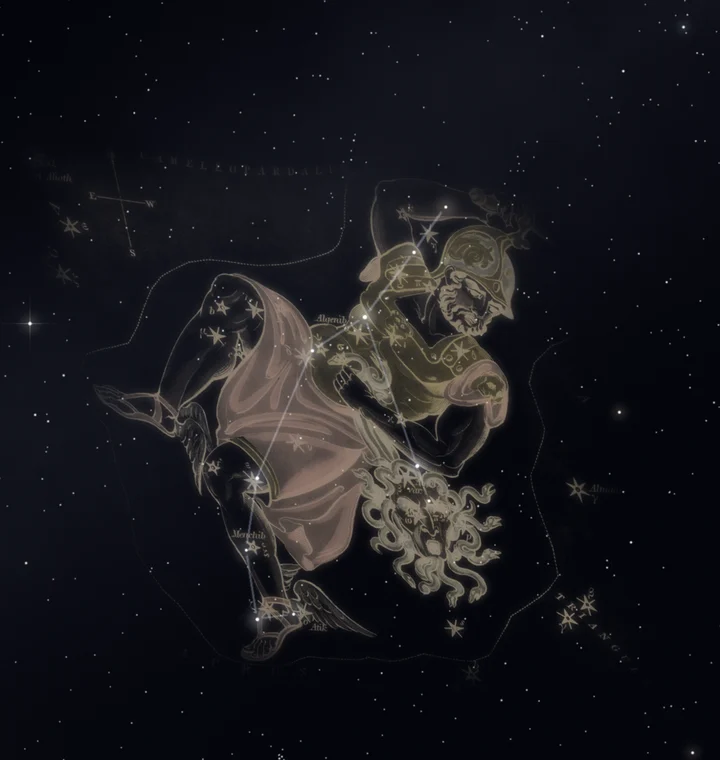
In Greek myth Perseus holds up the head of Medusa, and the star Algol shines in it. Sidney Hall drew him this way in Urania's Mirror (1824).
Read the whole story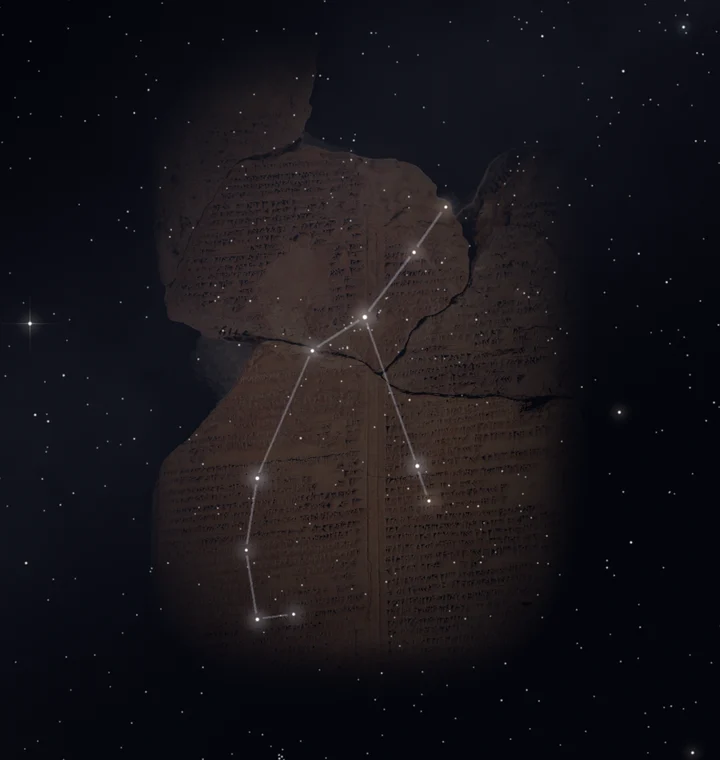 Babylon
In Neo-Assyrian times these stars were the Old Man (SU.GI). The MUL.APIN star text, written on clay tablets like this one, links them with the east.
 Arabia
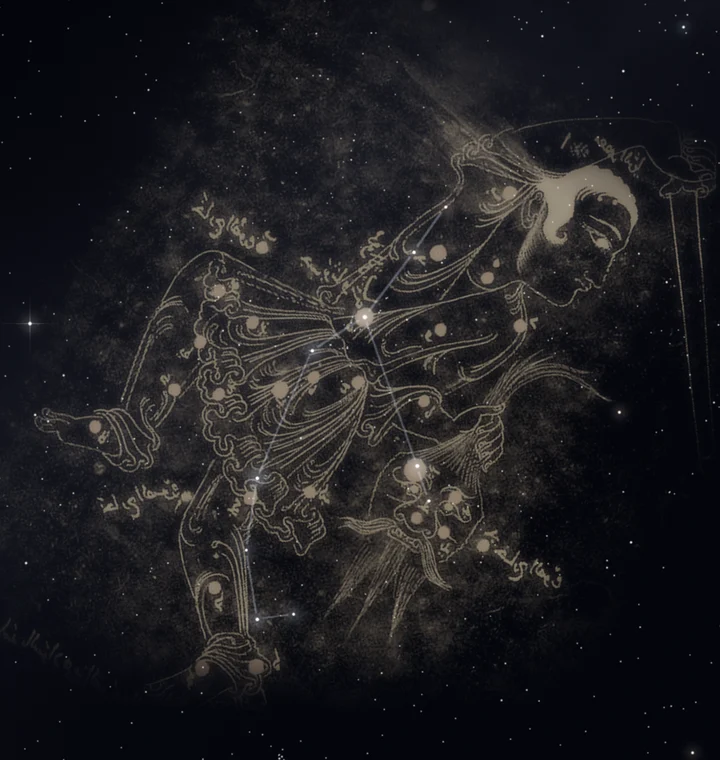
Arab astronomers called Perseus the bearer of the demon's head, and the star in that head ra's al-ghul, the ghoul's head, which became Algol. This is al-Sufi's drawing from his Book of the Fixed Stars.
 Algol, the Gorgon's eye
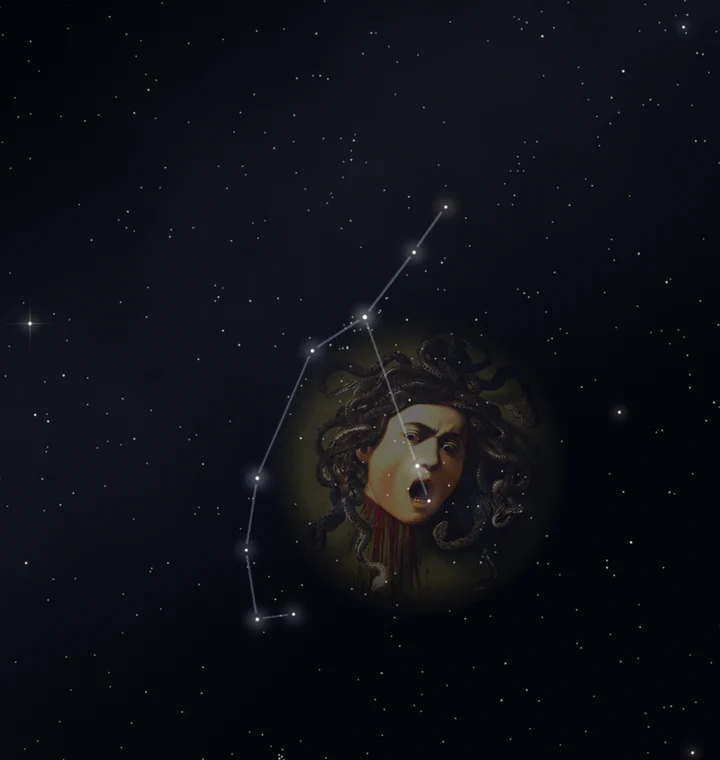
Algol fades for about ten hours every two days and 21 hours, when a dimmer companion star passes in front of it. Many peoples gave it a fearful name. Caravaggio painted Medusa's head on a shield.
 Medieval Europe
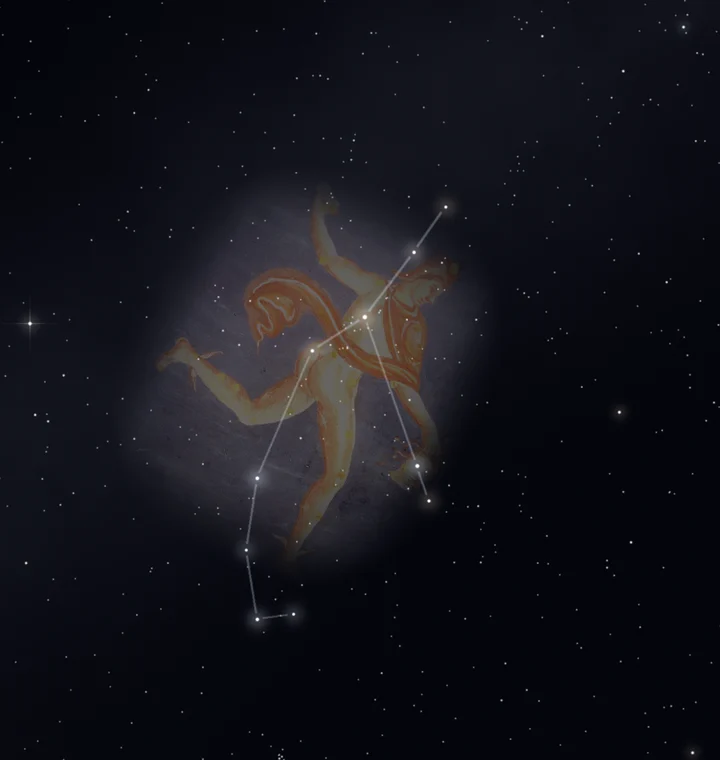
The Leiden Aratea, a manuscript made in the 9th century from a Roman original, paints Perseus running with the Gorgon's head, gold spots marking his stars.
 Poland
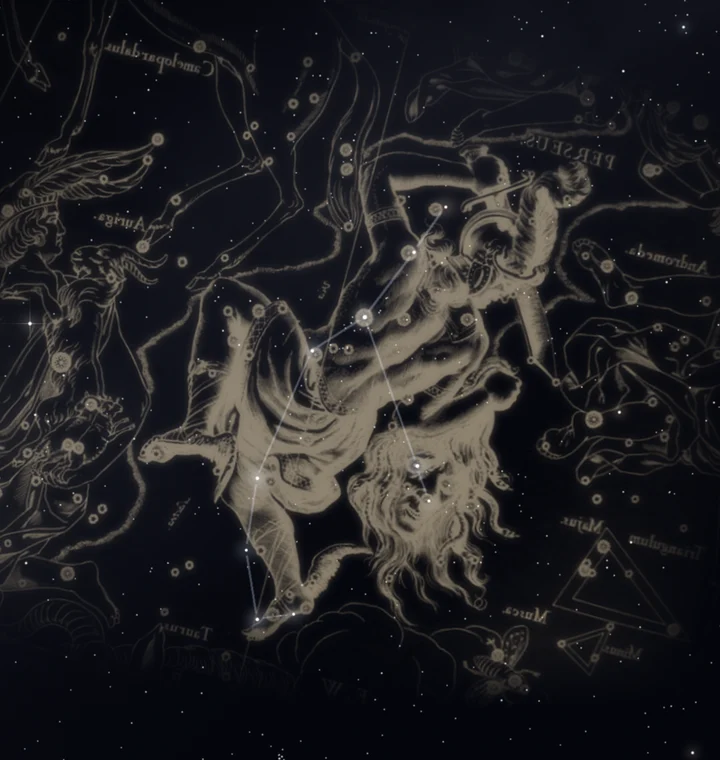
Johannes Hevelius of Gdańsk drew Perseus in his star atlas of 1690. He drew the sky as seen from outside a globe, so the picture is flipped here to match the sky you see.
 China
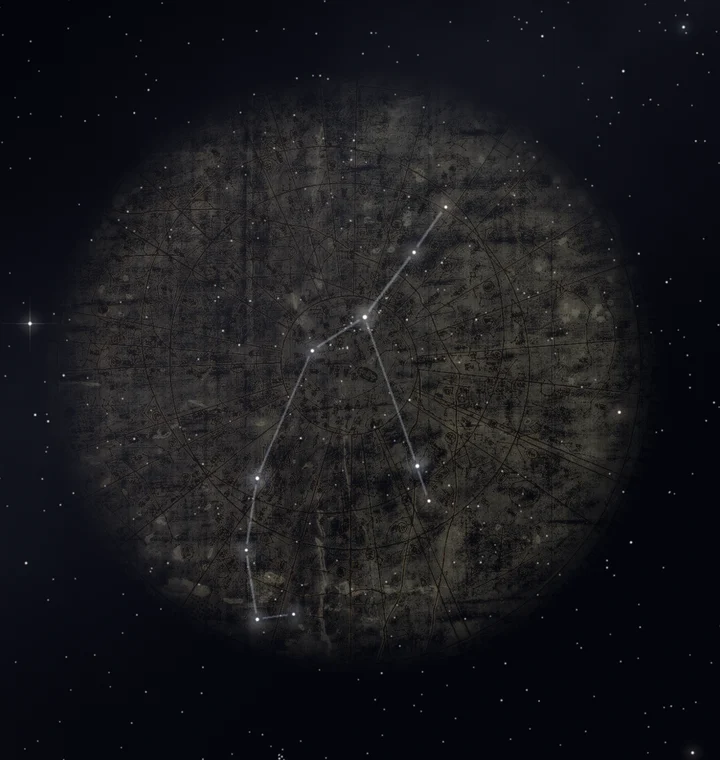
Chinese astronomers saw here the Celestial Boat (Tianchuan), a reminder to build boats before the late-summer floods, and the Great Mausoleum (Daling) round Algol. This star chart was carved in stone at Suzhou in 1247.
Perseus and the Gorgon's head (Greek)
An oracle told Acrisius, king of Argos, that his daughter Danaë would bear a son who would kill him. He shut her in a bronze chamber under the ground, but Zeus came to her as a stream of gold through the roof, and she bore Perseus. Acrisius put mother and child in a chest and cast it into the sea. It washed ashore on the island of Seriphos, where Dictys took them in and raised the boy.
Dictys's brother Polydectes, king of the island, wanted Danaë. He called his friends together, Perseus among them, and asked each for a horse as a gift. Perseus had boasted he would not refuse even the Gorgon's head, so when he brought no horse, Polydectes ordered him to bring the head.
Guided by Hermes and Athena, Perseus went to the Graeae, three sisters of the Gorgons who were old from birth and shared one eye and one tooth. He took the eye and the tooth and gave them back only when they showed him the way to the nymphs. The nymphs gave him winged sandals, a bag called the kibisis and the cap of Hades, which hid him from sight. Hermes gave him a sickle of adamant.
He flew to the edge of the ocean and found the three Gorgons asleep. Their heads were wound with scales like a dragon's, and anyone who looked at them turned to stone. Only Medusa could die. Looking only at her reflection in a bronze shield, with Athena guiding his hand, Perseus cut off her head, and the winged horse Pegasus and Chrysaor sprang from her body. He put the head in the bag, and when her sisters woke and chased him, the cap kept him hidden.
In Ethiopia he found the princess Andromeda chained to a rock for a sea monster, because her mother Cassiepea had boasted she was more beautiful than the Nereids. Perseus killed the monster and won Andromeda, and when her uncle Phineus plotted against him, he turned him to stone with the Gorgon's head. Back on Seriphos he turned Polydectes and his friends to stone too, made Dictys king, and gave the head to Athena, who set it in the middle of her shield.
Later, at funeral games in Larissa, Perseus threw a discus that struck Acrisius on the foot and killed him. Acrisius had fled there in fear of the oracle, and so it came true. In the autumn sky Perseus stands beside Andromeda, Cassiopeia and Cepheus, and Algol shines in the Gorgon's head he holds.
Source: Apollodorus, Library 2.4.1–4, translated by J. G. Frazer (1921)
Around the world
Greek and Roman
Perseus was the son of Danaë. King Polydectes sent him to fetch the head of Medusa. When Medusa died, the winged horse Pegasus and the warrior Chrysaor sprang from her body. Back home, Perseus turned Polydectes and his followers to stone and made Dictys, a fisherman, king in his place. The Romans called the constellation "Perseus and Medusa's Head", and Algol was also known as Gorgonea Prima, "first star of the Gorgon".
Mesopotamian (Babylonian)
In Neo-Assyrian times these stars were the Old Man (SU.GI). The MUL.APIN star text links them with the east.
Arabic and Hebrew
Algol comes from the Arabic ra's al-ghul, "head of the ghoul (or ogre)", which also gave the English name "Demon Star". In Hebrew folklore, as reported by the 17th-century writer Edmund Chilmead, it was "Satan's Head". Some Arabic atlases also drew the arm of the henna-dyed "Tinted Hand" of Cassiopeia across the stars of Perseus.
Chinese
Chinese astronomers linked these stars with the flood season. Tianchuan, the Celestial Boat, stood for the boats people were reminded to build in case of a bad flood year. Next to it, Jishui, the Swollen Waters, stood for unusually high floods in late August and early September. A more sombre group, Daling, the Great Trench (or Mausoleum), with Algol among its stars, stood for the graves of executed criminals. The bright pair of star clusters known as the Double Cluster had special importance.
Polynesian and Māori
Few Polynesian peoples named Perseus. The Society Islanders called it Faa-iti, "Little Valley". Some think the Māori star Matohi, "Split", was Algol. Matohi was said to quarrel with another star over which should be in the sky, and the outcome changed the tides.
Folk beliefs and customs
- Build your boats. The Chinese Celestial Boat and Swollen Waters worked as a sky-reminder of the coming flood season in late summer.
- The winking eye. Several cultures gave Algol a frightening name: the ghoul's head in Arabic, Satan's Head in Hebrew folklore, the Spectre's Head (Caput Larvae) in 16th-century Latin, and the Gorgon's eye in Greek and Roman tradition.
- One story, many constellations. Andromeda, Cepheus, Cassiopeia, Cetus and Pegasus all lie around Perseus, so the whole Greek tale can be followed across the autumn sky.
Free during the beta.
On Prismtect you write any sentence, a glass prism turns it into eight numbers, and a constellation is drawn in the sky for it, with a card to keep. Your sentence is not shown on the card.
Milky Way wallpapers in 4K
A moving wallpaper you can touch (Windows)
More constellations
- Andromeda
- Aquila
- Auriga
- Bootes
- Canis Major
- Cassiopeia
- Cepheus
- Columba
- Corona Borealis
- Corvus
- Crux
- Cygnus
- Delphinus
- Draco
- Hercules
- Hydra
- Lepus
- Lyra
- Orion
- Pegasus
- Sagitta
- Ursa Major
- Ursa Minor
Pictures and star positions
Each picture is a work from Wikimedia Commons, set over star positions from the HYG Database v4.0 (astronexus), CC BY-SA 4.0. The licence of each work is given below.
- Greece: Sidney Hall, Urania's Mirror: Perseus and Caput Medusae (1824) (Public domain)
- Babylon: MUL.APIN tablet, VAT 9412 (CC0)
- Arabia: al-Sufi, Book of the Fixed Stars: Perseus (Bodleian Library, Marsh 144) (CC BY 4.0)
- Algol, the Gorgon's eye: Caravaggio, Medusa (Public domain)
- Medieval Europe: Leiden Aratea, fol. 40v: Perseus (9th century) (Public domain)
- Poland: Johannes Hevelius, Uranographia: Perseus (1690) (Public domain)
- China: Suzhou planisphere (map by Huang Shang, carved by Wang Zhiyuan, 1247), rubbing (Public domain)
- Star positions: HYG Database v4.0 (astronexus), CC BY-SA 4.0


